
Table of Contents
- How to Assess Crack Severity Before You Repair a Cracked Concrete driveway
- Tools Needed for Concrete Crack Repair
- Cleaning, Widening and Preparing the Crack for Filling
- Best Concrete Crack Filler for Driveways: Matching the Product to the Crack
- Step-by-Step: Applying Filler, Smoothing and Finishing the Repair
- Curing, Sealing and Maintenance Through Seasonal Weather Swings
- Is Concrete Resurfacing Worth It for Driveways With Extensive Cracking?
- Frequently Asked Questions
Last Updated: September 13, 2026
How to Assess Crack Severity Before You Repair a Cracked Concrete driveway
A cracked concrete driveway is not one problem but several, and the fix depends on which one you have. At Pebble Mix, we have over 50 years of experience working with concrete surfaces across Victoria, and the most common mistake we see is homeowners filling a crack that should never have been filled.
Before buying sealant, work out what you are looking at. Cracks fall into two groups that demand different responses.
Hairline Cracks vs Structural Cracks
Hairline cracks are fissures under 3 mm wide that run across the surface without displacing either side (Publications & Reports). They are usually cosmetic, caused by shrinkage as the concrete dries, and are candidates for simple filling.
Structural cracks are wider, often 5 mm or more, with one side sitting higher than the other. They may zigzag, follow expansion joints, or branch into a web pattern, signalling that the slab or sub-base has moved. Filling one without addressing the cause is a temporary patch at best.
When a Crack Signals a Bigger Problem
Watch for these warning signs:
- The two sides of the crack are at different heights
- The crack is wider than a 10-cent piece
- Cracks radiate from a corner or run the full width of the slab
- Concrete spalling, where the surface is flaking or crumbling away
- Water pools in the same spot after every rain event
If you see any of these, the issue is likely the sub-base, drainage, or slab movement, not the surface. A repair kit will not solve it.
Filling a structural crack without fixing the underlying movement traps the problem under a neat-looking surface. It will reappear, often wider, within a single season.
Tools Needed for Concrete Crack Repair
The tools needed for concrete crack repair are straightforward, and most homeowners own half of them. What matters is the right finishing tool and cleaning gear, because surface preparation drives how long the repair lasts.
Gather these before you start:
- Wire brush and stiff-bristled hand brush
- Vacuum or compressed air blower
- Cold chisel and hammer, or an angle grinder with a diamond blade
- Caulking gun or trowel, depending on the filler type
- Putty knife and a concrete finishing tool
- Bucket and mixing paddle for patching compound
- Safety gear: P2 respirator, safety glasses, and gloves
Silica dust from grinding or brushing dry concrete is the hazard most homeowners ignore. Wet the crack slightly before brushing, and always wear a P2 respirator. It is a five-minute precaution that protects your lungs for life.
Cleaning, Widening and Preparing the Crack for Filling
Surface preparation is where most DIY repairs fail. Filler bonds to clean, rough, dry concrete, not to dust, loose aggregate, or a crack too narrow for the material to penetrate.
Follow these steps:
- Remove all loose material with a wire brush, working along the full length of the crack.
- Vacuum or blow out the debris. Repeat until the crack is visibly clean.
- Widen narrow cracks using a cold chisel or grinder so the filler can reach the full depth. Aim for a width roughly equal to the depth.
- Check for moisture. The crack must be dry unless your product specifies a damp surface.
- Apply a bonding agent if your filler requires one, following the manufacturer’s directions.
The goal is an inverted-V shape: wider at the surface, tapering down, giving the filler grip and room to flex with the slab.
Best Concrete Crack Filler for Driveways: Matching the Product to the Crack
The best concrete crack filler for driveways depends on crack width, movement, and whether you need a flexible or rigid result. No single product suits every situation, and choosing wrong is why so many repairs fail within a year.
Polyurethane Filler vs Epoxy Injection vs Patching Compound
| Filler Type | Best For | Movement Tolerance | Notes |
|---|---|---|---|
| Polyurethane filler | Cracks up to 20 mm, active joints | High, flexes with slab | Self-levelling grades available |
| Epoxy injection | Hairline to 5 mm, structural bonding | Low, rigid | Needs injection ports and a steady hand |
| Patching compound | Wide cracks, spalled edges | Low to moderate | Trowel-applied, blends with surface |
| Quick-setting cement | Deep holes, vertical faces | Low | Sets fast, poor flexibility |
Polyurethane sealant suits driveways because it moves with the slab through temperature swings. Epoxy injection restores structural integrity in a hairline fracture but cracks again if the slab keeps moving. Patching compound handles wider gaps and matches the surrounding texture.
For driveway joint sealant along expansion joints, a flexible polyurethane is almost always the right call.
Why Climate Changes the Answer
Most product guides assume a generic climate, but a material that works in a mild, dry region can fail within a season where summers are hot and winters wet. Two mechanisms drive most premature failures:
- Thermal movement. Concrete expands and contracts daily. A rigid filler (epoxy, cement) cannot accommodate that movement and will crack along the bond line. A flexible polyurethane stretches and recovers, which is why it is the default for any crack that is still active.
- Moisture cycling. Water entering a crack, then freezing, then thawing, widens it progressively. A filler that is not fully bonded or that is too brittle will be pushed out. In wet-winter regions, a flexible sealant with good adhesion is more important than high compressive strength.
A practical rule: if the slab sees full sun and temperature swings, choose flexibility over rigidity. If it is shaded, stable, and not moving, a rigid repair is acceptable.
Matching the Repair to the Existing Concrete
A structurally sound repair that looks like a scar is still a failed repair. Two things matter for appearance:
- Colour. Cured concrete lightens over time, so a fresh grey patch looks darker for months. Some manufacturers offer tinted sealants or colour packs; where they do not, dusting fine sand or matching concrete dust into the wet surface reduces contrast.
- Texture. A trowel-smooth patch on a broom-finished driveway stands out. Drag a damp sponge, stiff broom, or hessian across the wet filler to replicate the surrounding finish while it is still workable.
Buy a small tube of the product first and test it on an inconspicuous crack near the edge of the slab. Check the colour and texture after it cures. It is a cheap way to avoid a visible mismatch across the whole driveway.
Product Forms and What They Suit
- Self-levelling sealant: flows into horizontal cracks and joints; good for flat driveway surfaces, poor for slopes or vertical faces.
- Non-sag sealant: stays put on vertical or overhead surfaces; useful for spalled edges and step faces.
- Injection epoxy: low viscosity, designed to be pumped into hairline cracks through ports; restores bond but not flexibility.
- Trowel-grade patching compound: for wide cracks and missing sections; can be built up in layers.
- Hydraulic cement: sets fast and can be applied to damp surfaces; useful for deep holes, but brittle and prone to cracking under movement.
Match the form to the geometry first, then the chemistry to the movement. A self-levelling product on a sloped driveway will simply run out of the crack before it sets.
Step-by-Step: Applying Filler, Smoothing and Finishing the Repair
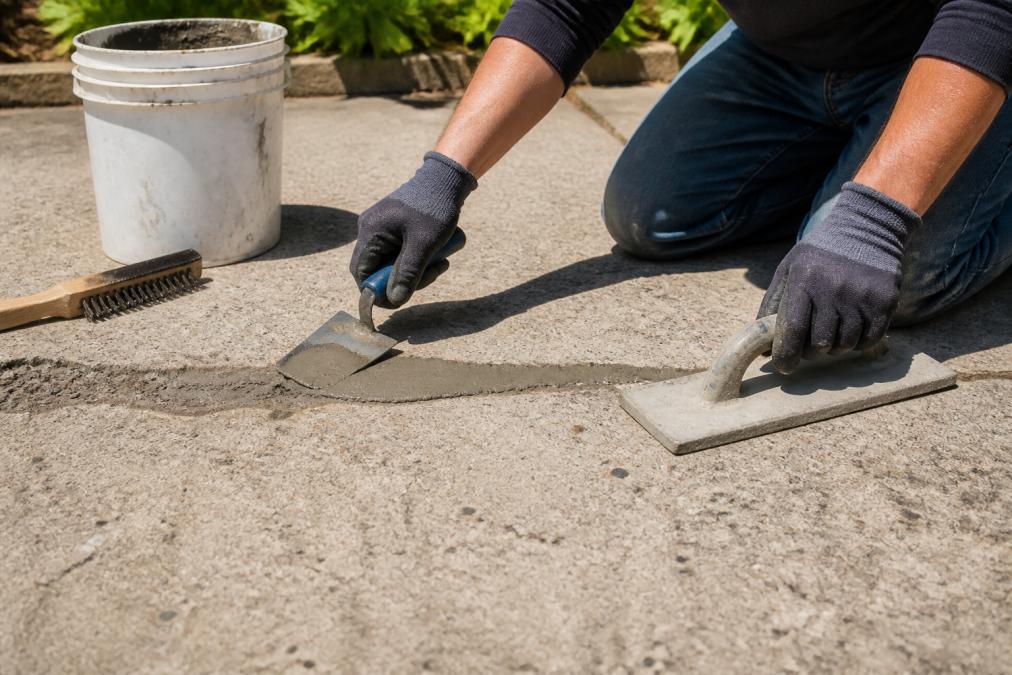
Applying filler takes patience, not strength. Work in shade if possible and avoid the hottest part of the day.
- Mix your patching compound or load your sealant tube according to the label.
- Fill from the deepest point upward, working in sections no longer than a metre.
- Overfill slightly, then compress the material with a trowel or finishing tool.
- Match the surface texture by dragging a damp sponge or broom bristles across the wet filler.
- Feather the edges so the repair blends into the surrounding concrete.
- Clean excess material from the surface before it sets.
For a polished result, mist the tool with a spray bottle as you work to stop the filler dragging and give a cleaner edge.
Aesthetic matching matters more than most guides admit. A perfectly structural repair that looks like a scar will bother you every time you pull into the driveway.
Curing, Sealing and Maintenance Through Seasonal Weather Swings
Curing time and weatherproofing determine whether your repair survives its first winter. Most fillers need 24 to 48 hours before foot traffic and several days before vehicles, though quick-setting cement can be driven on sooner (Datasheets). Always check the label, because times vary widely.
Once cured, seal the repair and surrounding slab with a concrete sealer. It acts as a moisture barrier and slows the freeze-thaw and wet-dry cycling that opens cracks.
Seasonal maintenance for a cracked concrete driveway looks like this:
- Inspect expansion joints and joint sealant each autumn
- Reapply sealant where it has pulled away from the edges
- Clear debris from cracks before winter rain
- Address new hairline cracks while they are still narrow
Victoria’s wet winters and hot summers stress concrete. A driveway that drains well and stays sealed will outlast one that is merely patched.
Is Concrete Resurfacing Worth It for Driveways With Extensive Cracking?
Concrete resurfacing is worth it when the slab is sound but the surface is riddled with cracks, spalling, and staining. When weighing whether concrete resurfacing is worth it for driveways with widespread cracking, the deciding factor is the sub-base, not the surface.
Resurfacing adds a new wearing layer over the existing slab, hiding hairline cracks, restoring a uniform finish, and improving slip resistance and drainage. It cannot hold together a slab that is still moving; if the sub-base is failing, resurfacing is money spent on a surface that will crack again.
A Decision Framework: Patch, Resurface, or Replace
Most guides stop at ‘call a professional.’ A more useful approach is to work through three questions in order.
1. Is the slab still structurally sound?
Check for these signs of a failing slab:
- Cracks wider than about 6 mm with vertical displacement between the two sides
- Multiple cracks radiating from a single point, or a web pattern across a large area
- Hollow-sounding concrete when tapped with a hammer or the handle of a screwdriver
- Visible sinking, rocking, or ponding water that does not drain
- Cracks that reappear within weeks of being filled
If two or more of these are present, the slab is likely moving and resurfacing is not the right answer. The sub-base needs attention first, which usually means removal and replacement of the affected section.
2. Is the damage surface-only?
If the cracks are hairline, stable, and the slab does not move underfoot, the damage is cosmetic. Patching individual cracks is the cheapest option and can be repeated as needed. Resurfacing becomes worthwhile when the number of cracks makes individual patching impractical, or when spalling and staining have made the surface uniformly tired.
3. What is the long-term cost comparison?
Patching is low-cost but recurring. Resurfacing costs more upfront but resets the surface for years. Replacement is the highest cost and most disruptive, but the only option that fixes a failed sub-base. Homeowners often spend more on repeated patching over five years than a single resurfacing would have cost, making resurfacing better value once cracks become widespread.
What Resurfacing Cannot Fix
Be sceptical of any quote that promises resurfacing will solve everything. It will not fix:
- A sub-base that has settled or heaved
- Poor drainage that directs water under the slab
- Tree roots lifting the slab
- Cracks that are still actively moving
In these cases, resurfacing is a cosmetic layer over a structural problem. It may look good for one season, then crack along the same lines as the original slab.
Where Resurfacing Genuinely Adds Value
For driveways where the concrete is stable but tired, resurfacing is often better value than repeated patching. It also opens the door to UV-resistant, easy-clean finishes far more attractive than grey concrete, colour-matched to the home, textured for slip resistance, and sealed to resist oil and garden dirt.
That is where Pebble Mix comes in. Our pebble paving is laid over prepared concrete surfaces to deliver a durable, non-slip finish that handles oil spots, garden dirt, and wet pool surrounds. Customers like John Coleman have seen a 20-year-old pool area come back looking brand new, and Lea Robinson had the colour customised to suit her home.
If you are on a fixed income and weighing up cost, the honest answer is that pricing depends on the area, surface condition, and finish you choose. Call us today for a quote rather than guessing from a generic online figure.
Frequently Asked Questions
Can you repair a badly cracked concrete driveway, or does it need replacing?
It depends on the cause. If cracks are wider than about 6 mm, run deep, or the slab has lifted or sunk, patching alone will not hold. In those cases the sub-base or slab needs attention first. For cracks under 6 mm with no movement, cleaning, filling with a polyurethane filler or patching compound, and sealing usually restores the surface. A professional assessment is worth it when you are unsure whether the crack is cosmetic or structural.
What are the common mistakes to avoid when repairing concrete cracks?
The biggest mistakes are filling dirty or damp cracks, skipping the widening step on narrow hairline cracks, and using the wrong product for the crack width. Filling over a crack that is still moving will fail within months. Not compacting the sub-base under a sunken slab, and not allowing full curing time before driving on the repair, are also common. Surface preparation and correct product choice decide how long the repair lasts.
How do I choose the best concrete crack filler for driveways?
Match the filler to the crack. Hairline cracks take a thin patching compound or slurry. Cracks 3 to 6 mm wide suit a flexible polyurethane filler or joint sealant that moves with the slab. Structural cracks and spalling edges often need epoxy injection for load-bearing strength. For driveways exposed to sun and rain, pick a UV-resistant, weatherproofing-grade product. Check the label states it is suitable for vehicle traffic before you buy.
When should you call a professional for driveway repairs?
Call a professional when cracks are wider than 6 mm, when the slab has shifted, when cracks return within a year of repair, or when you are dealing with spalling across a large area. Extensive cracking often means the base or drainage needs fixing, not just the surface. A resurfacing or pebble paving system can cover hairline cracks and restore appearance, but the underlying cause must be addressed first for the finish to last.