Table of Contents
- What Makes Patio Flooring Durable Enough for a Family?
- Slip-Resistant Outdoor Flooring: Testing the Surface Before You Commit
- Surface Temperature and Impact: The Two Safety Gaps Most Guides Skip
- Low Maintenance Patio Surfaces: What You’ll Actually Be Doing Each Year
- Resurfacing Concrete Patios vs Laying New: Which Path Fits Your Budget?
- Choosing Materials That Stay Safe in the Heat and Rain
- Drainage, Repairability and the Questions to Ask Before You Sign
- Frequently Asked Questions
Last Updated: September 11, 2026
What Makes Patio Flooring Durable Enough for a Family?
Durable patio flooring for families is a surface that survives daily foot traffic, wet weather, hot summers and the occasional dropped bike without cracking, lifting or turning into a hazard. At Pebble Mix, we’ve spent more than 50 years installing pebble paving across Victoria, and the surfaces that last are the ones matched to how a family actually uses the space, not just how it looks on day one.
Here’s the uncomfortable truth most buying guides skip: durability and safety are the same conversation. A surface that stays grippy when wet, resists UV bleaching and drains properly will outlast one chosen purely on colour. The guide below covers the five failure points, the two safety gaps most articles ignore, and how to decide between resurfacing and starting fresh.
The Five Things That Actually Break a Patio Surface
Most failures trace back to one of five causes: poor sub-base preparation, water pooling because drainage was an afterthought, thermal expansion cracking rigid surfaces, UV fading on cheap finishes, and impact damage from heavy furniture or dropped objects. Get the sub-base and drainage right and you eliminate the majority of long-term problems before a single tile is laid.
| Failure Point |
|---|
| — |
| Sub-base failure |
| Water pooling |
| Thermal cracking |
| UV fading |
| Impact damage |
Slip-Resistant Outdoor Flooring: Testing the Surface Before You Commit
Slip-resistant outdoor flooring is any surface with enough texture to maintain grip when wet, and the reliable test is a wet-and-dry comparison rather than a showroom sample. Ask to walk on a wet section of the actual material, ideally in the finish and colour you’re buying, because texture depth and sealer choice both change how a surface behaves underfoot.
Wet and Dry Grip: Where Most Surfaces Fail
Glossy poured concrete and smooth clay bricks are the usual offenders. They feel fine dry and turn genuinely dangerous after rain or a splash from the pool. Textured finishes and exposed aggregate hold grip far better because water drains away from the contact point instead of sitting on a slick film. If you’re choosing around a pool surround, treat wet grip as the primary specification, not a nice-to-have.
Sealing a smooth surface with a high-gloss product can undo its grip. A sealer that looks impressive on a display board may leave a wet patio more slippery than the bare concrete it replaced.
Surface Temperature and Impact: The Two Safety Gaps Most Guides Skip
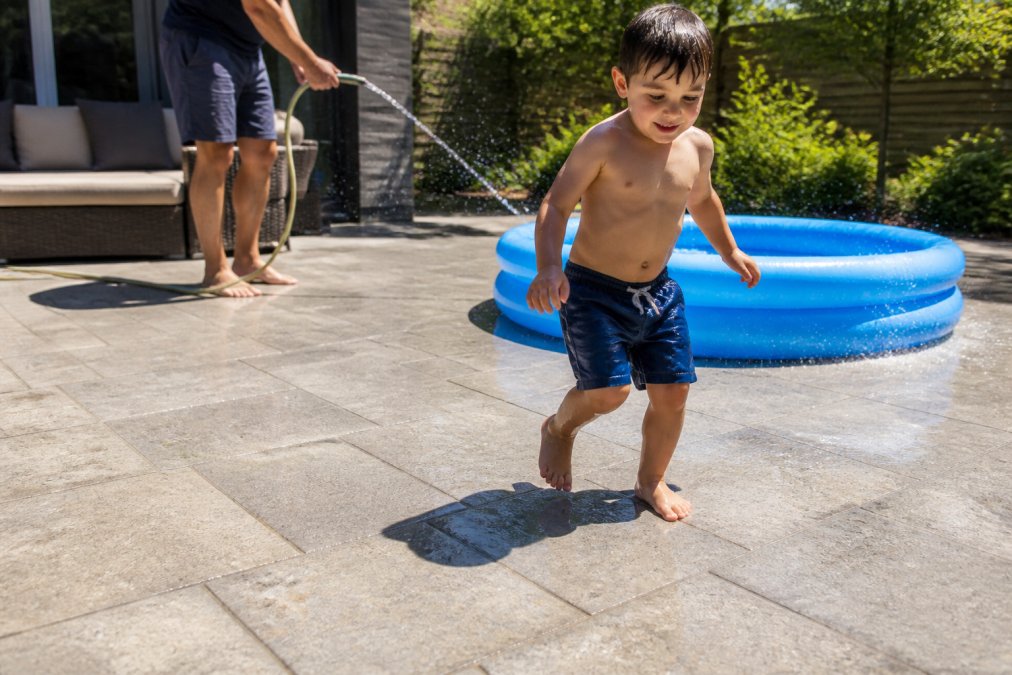
Surface temperature and impact absorption are the two safety factors that decide whether a patio is genuinely child-safe, and they rarely appear in standard buying advice. Dark paving in full summer sun can become uncomfortable or unsafe for bare feet, while a hard, unforgiving surface turns a minor tumble into a serious injury. The Australian Competition and Consumer Commission (ACCC) provides guidance on product safety, though specific standards for patio surfaces are not detailed.
Why Some Surfaces Get Hot Enough to Burn
Surface temperature is driven by how much solar radiation a material absorbs and how quickly it releases that heat. Dark colours absorb more of the sun’s energy than light ones, and dense, low-porosity materials such as concrete, clay brick and natural stone hold that heat and radiate it back slowly, so they stay hot well after the sun has moved off them. Lighter colours and surfaces with more air or resin content reflect more energy and shed heat faster.
A dark concrete or brick surface in full summer sun can become uncomfortable to stand on within an hour, while a light-coloured, resin-bound pebble surface in the same position stays noticeably cooler. The exact difference depends on colour, texture, shade and wind, so the only reliable test is your own.
Test surface temperature yourself before committing. On a hot day, press your palm to a sample left in direct sun for an hour. If you can’t hold it there comfortably, a barefoot child won’t manage it either. Repeat the test in late afternoon, when stored heat peaks on dense surfaces.
Impact Absorption: Hardness and Give Are Not the Same Thing
Impact absorption is about how much a surface deforms under a falling body and how gradually it brings that body to a stop. A rigid surface such as concrete or stone barely moves, so almost all the energy of a fall is transferred back into the child. A resilient surface flexes slightly, spreading the deceleration over a longer distance and reducing peak force on a small body.
This is the same principle behind soft-fall surfaces in playgrounds, where the depth and resilience of the material are specified to a fall height. While a family patio does not need to meet playground safety standards, the principle still applies: the more give a surface has, the less punishing a tumble will be.
Resin-bound pebble paving sits between the two extremes. It is firmer than mulch or rubber but has more give than a rigid concrete slab, and its textured finish also improves grip when wet. For families with toddlers, that combination of moderate resilience and reliable traction is usually the practical sweet spot.
A Simple Way to Compare Two Surfaces
When you are weighing options, ask three questions of each sample:
- How hot does it get in direct sun, tested by hand at midday and again in late afternoon?
- How much does it flex under a dropped weight, such as a full water bottle dropped from waist height?
- How does it behave when wet, both for grip and for how long it stays slippery?
No single material wins on all three. The point is to choose with your eyes open rather than discovering the trade-off on the first hot day.
Low Maintenance Patio Surfaces: What You’ll Actually Be Doing Each Year
Low maintenance patio surfaces reduce your annual routine to sweeping, occasional rinsing and a periodic check of drainage, rather than resealing, re-grouting or patching. Grout lines are the hidden maintenance cost in tiled patios: they trap dirt, grow moss in shaded areas and need re-sanding every few years.
Pebble paving removes that problem entirely because it has no grout to fail. Its smooth, sealed finish resists staining from oil drips and garden dirt, and a quick hose-down handles most marks. For families juggling school runs and weekend sport, that difference in upkeep is often worth more than any aesthetic upgrade. Surfaces with fewer joints and no grout simply have fewer things to go wrong.
Resurfacing Concrete Patios vs Laying New: Which Path Fits Your Budget?
Resurfacing concrete patios is usually the faster and more affordable route when the existing slab is structurally sound, while laying new is the safer choice when the base is failing. The decision hinges on one question: is the problem cosmetic or structural?
What Resurfacing Can and Cannot Fix
Resurfacing handles hairline cracks, discolouration, surface wear and a dated finish. It cannot fix a slab that has sunk, heaved or broken into moving sections, because the new surface will simply crack along the same fault lines. A professional assessment tells you which category you’re in before you spend anything.
| Situation | Resurfacing | Laying New |
|---|---|---|
| Hairline cracks | Suitable | Unnecessary |
| Faded or worn surface | Suitable | Unnecessary |
| Slippery finish | Suitable | Unnecessary |
| Sunken or heaved slab | Not suitable | Required |
| Structural movement | Not suitable | Required |
For most families dealing with hairline cracks and a tired look, resurfacing delivers a durable, non-slip result without the cost and disruption of demolition. Pricing depends on area, existing condition and finish, so it’s worth requesting a quote rather than working from guesswork.
Choosing Materials That Stay Safe in the Heat and Rain
Materials that stay safe in heat and rain share three traits: UV stability, moisture resistance and a textured grip that survives wet conditions. The differences between common options show up in how they handle those three traits over years, not weeks.
How the Main Options Compare
Artificial grass stays soft underfoot and is popular with young children, but it absorbs and holds heat, can become uncomfortably warm in full sun, and traps moisture underneath unless the base drains well. It also needs periodic brushing and topping up with infill.
Soft-fall mulch offers the best impact absorption of any common option, which is why it dominates playgrounds, but it breaks down, compacts and needs topping up at least annually, and it can be tracked indoors.
Vinyl and composite decking is comfortable underfoot and cool enough in most conditions, but smooth or glossy boards can become slick when wet, and some composites fade or chalk over time depending on the formulation.
Paving stones and interlocking tiles are durable and repairable in sections, but their performance depends heavily on correct sub-base preparation, and joint sand or grout can erode, grow moss in shade and need re-sanding every few years.
Resin-bound pebble paving sits in a useful middle ground. It is UV resistant, so colours hold rather than bleaching; its sealed surface resists moisture penetration; and its texture maintains grip when wet. It has more give than rigid concrete or stone, though less than mulch or rubber.
A Parent’s Decision Framework
Rather than asking which material is best, ask which trade-off you can live with:
- If impact absorption is your priority, mulch or a rubber-based surface wins, at the cost of ongoing topping up.
- If low maintenance is your priority, resin-bound pebble or sealed paving wins, at the cost of a firmer surface.
- If coolness underfoot is your priority, light-coloured, low-density surfaces win, and dark dense materials lose.
- If repairability is your priority, modular tiles or resin-bound sections win over a monolithic pour.
The Non-Toxic Question
Parents increasingly ask about what is in the surface itself, not just how it performs. Sealers, binders and colourants can off-gas for a period after installation, and the intensity depends on the product and the weather. A reasonable approach is to ask the installer what binder or sealer is being used, whether it is solvent-based or water-based, and how long the surface should be left before children use it. Water-based products generally have a shorter and milder curing period than solvent-based ones. If a supplier cannot answer those questions clearly, treat that as a signal.
If you’re weighing aesthetic appeal against durability, this is where the two stop competing: a finish that resists fading and staining looks better for longer by default, and a surface that stays cool and grippy is one children will actually use.
Drainage, Repairability and the Questions to Ask Before You Sign
Drainage and repairability are the two questions to settle before signing anything, because both are far cheaper to solve during installation than after. Water that pools after rain signals a fall or drainage problem, and no surface finish will fix it on its own. Ask directly how the installer will manage run-off away from the house.
Repairability matters just as much. Modular surfaces let you lift and replace a single damaged section; a monolithic pour usually means patching a visible scar. Pebble paving is repairable in sections, which matters when a heavy pot or a shifting garden bed damages one area.
Before you sign, get written answers to three questions: How is drainage handled? What’s the fall away from the house? And can a damaged section be repaired without redoing the whole patio?
A quick checklist for your next conversation with any installer:
- Confirm sub-base depth and compaction method
- Ask for the drainage plan in writing
- Test wet grip on a real sample
- Check surface temperature in direct sun
- Confirm UV stability of the finish
- Ask how a single damaged section is repaired
- Request a written quote covering the full area
Frequently Asked Questions
What is the best low maintenance outdoor flooring for a family home?
The lowest-effort options are sealed resin-bound or pebble finishes over a concrete base, large-format interlocking tiles with tight joints, and vinyl decking. Each needs little more than a periodic sweep and hose-down. Avoid surfaces with wide grout lines, loose gravel or soft-fall mulch, which need topping up, raking and weed control through the year. If you want the least ongoing work, choose a continuous surface with no joints for weeds to colonise.
How do I choose slip-resistant outdoor flooring for a patio used by children?
Test the surface wet, not dry. Ask for a sample and pour water over it, then walk across it in the shoes your family actually wears. Look for a textured finish rather than a smooth polished one, and check that the texture is part of the material rather than a coating that will wear away. Around pools and paths, prioritise grip over shine, and confirm how the surface drains so water does not sit on top of it.
Can resurfacing concrete patios fix hairline cracks and drainage problems?
Resurfacing covers hairline cracks and restores a tired slab, and a properly built-up finish can be shaped to direct water toward an existing drain or outlet. It will not fix a structural slab that is heaving, sinking or badly broken, and it cannot replace a missing drainage point. Have the slab assessed first. If the base is sound, resurfacing is usually faster and cheaper than removing and relaying concrete.
How long does durable patio flooring for families actually last?
Lifespan depends on the base, the finish and how it is maintained. A well-prepared concrete base with a quality sealed finish that is cleaned regularly and resealed on schedule typically holds up for many years, while thin coatings over a cracked or damp slab fail early. Ask about the warranty terms in writing, what maintenance voids it, and whether the installer will return for repairs. Repairability matters as much as the initial lifespan.
Choosing the right surface for a family patio means balancing grip, heat, impact and upkeep, not just picking a colour you like. Pebble Mix has installed durable, UV-resistant and easy-to-clean pebble paving across Victoria for over 50 years, with customised colour options and a finish that transforms worn concrete into something built to last. Call us today to discuss your patio, pool surround or driveway and get a result your family can actually live on.