Table of Contents
- Quick Comparison: Pebblepave Alternatives for Pool Surrounds
- Slip Resistant Pool Paving Options for Safer Poolside Areas
- Resin Bound Permeable Gravel Cost: What Affects the Price
- Honed Concrete Pool Surrounds: Smooth Finish, Hidden Risks
- Travertine and Porcelain Pavers: Natural Stone and Tile Alternatives
- Heat Retention, Chemical Resistance and Long-Term Repair
- DIY vs Professional Installation for Pool Surrounds
- Conclusion
- Frequently Asked Questions
Last Updated: September 18, 2026
Quick Comparison: Pebblepave Alternatives for Pool Surrounds
If you’re hunting for a Pebblepave alternative for pool surrounds, the honest answer is that the right choice depends on three things: how much heat the surface holds, how it handles water, and how it copes with chlorine and salt over time. This guide from Pebble Mix compares five options on those criteria.
The five options we cover are resin-bound permeable paving, honed concrete, travertine pavers, porcelain pavers, and handcrafted concrete pavers. Each has a genuine place around a pool. None is perfect.
|
Option |
Slip Resistance |
Heat Retention |
Chemical Resistance |
Best For |
|---|---|---|---|---|
|
Resin-bound permeable paving |
High |
Moderate |
Good with polyurethane resin |
Pool surrounds needing drainage |
|
Honed concrete |
Low when wet |
High |
Good |
Shaded, low-traffic areas |
|
Travertine pavers |
High |
Low |
Good, needs sealing |
Natural stone look |
|
Porcelain pavers |
Varies by R-rating |
Moderate |
Excellent |
Low-maintenance families |
|
Handcrafted concrete pavers |
Moderate to high |
Moderate |
Good, needs sealing |
Budget stone lookalike |
The gap most comparison pages leave open is heat. A surface that stays cool underfoot matters more around a pool than almost any other factor, because barefoot comfort decides whether the space actually gets used.
Slip Resistant Pool Paving Options for Safer Poolside Areas
Slip-resistant pool paving options work by giving water somewhere to go. A porous surface or a textured finish breaks the film of water that makes smooth concrete dangerous when wet.
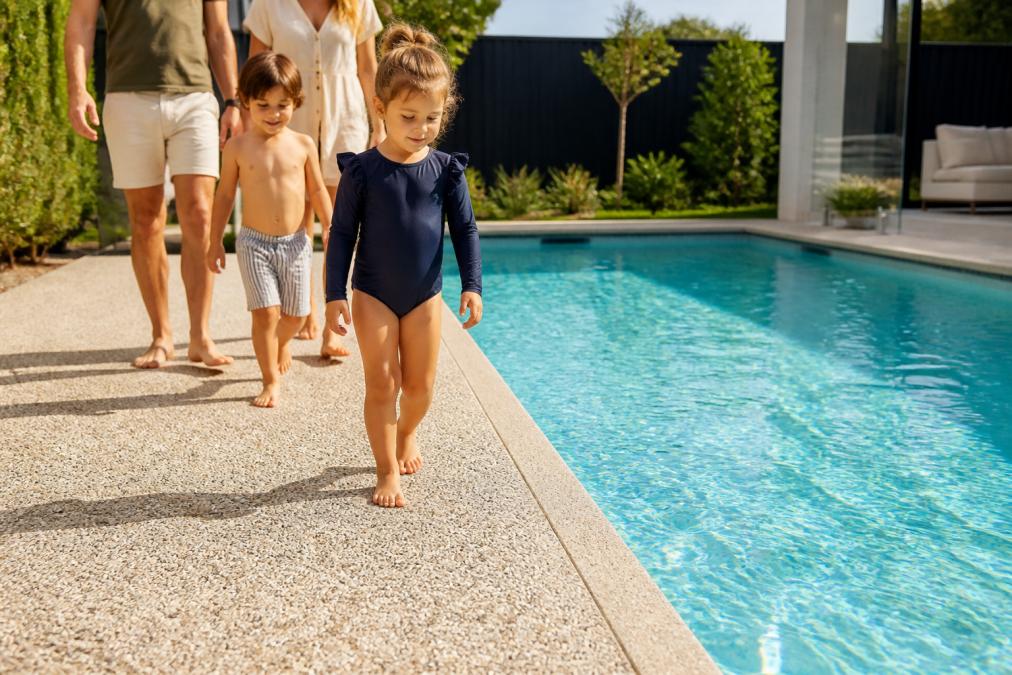
Around a pool, the surfaces that perform best are:
- Pebble-Mix Resin-bound permeable paving: an open matrix of aggregate held in polyurethane resin, so water drains straight through.
- Travertine pavers: the natural porosity of the stone provides grip even when soaked.
- Textured porcelain: only where the product carries a genuinely high slip rating, since smooth porcelain is a hazard.
Honed concrete is the one to treat with caution. Its smooth finish looks superb, but it becomes slick when wet, which is exactly the condition a pool surround lives in.
Resin Bound Permeable Gravel Cost: What Affects the Price
Resin-bound permeable gravel cost depends on the area, the aggregate chosen, the depth of the sub-base, and whether the existing surface needs removal first. Pricing is quoted per square metre, and the spread between a cheap job and a good one is wider than most homeowners expect.
Rather than publish a single national figure, it helps to understand the cost mechanics. Every quote is built from the same five inputs, and each one moves the number:
- Area size. Larger areas lower the per-square-metre rate because fixed setup, travel and mixing costs are spread across more square metres. A small courtyard surround carries a higher rate per square metre than a 60 m² pool deck.
- Aggregate type and size. Standard washed stone sits at the budget end. Quartz, marble and specialty blends cost more, and finer aggregate grades use more resin per square metre because the surface area to coat is greater.
- Resin type. A UV-stable polyurethane binder costs more than a cheaper aromatic resin up front, but it is the single biggest determinant of whether the surface still looks uniform after five summers of direct sun. This is the line item worth paying for.
- Sub-base condition and depth. A stable, well-drained base may only need a light screed. A failing base needs excavation, new compacted road base and a re-established fall away from the coping and the house. This is the most commonly under-quoted component.
- Access and drainage. Tight side access slows barrowing and mixing. Sites that pool water need extra groundwork, and sloping surrounds need the fall built into the base rather than the surface.
Because so much depends on site conditions, we don’t publish fixed figures. Any installer quoting a flat rate without seeing the site is guessing.
One cost that rarely appears in quotes but matters over the life of the surface is repairability. Resin-bound paving can be patched in small sections, so a cracked or stained square metre does not force a full resurface. That changes the whole-of-life cost calculation in its favour compared with poured concrete, where a single crack can mean resurfacing the entire area.
Honed Concrete Pool Surrounds: Smooth Finish, Hidden Risks
Honed concrete pool surrounds deliver a smooth, contemporary finish that photographs beautifully. The problem is what happens when they get wet.
Travertine and Porcelain Pavers: Natural Stone and Tile Alternatives
Travertine and porcelain pavers are the two most common hard-surface alternatives to pebble paving, and they solve different problems.
Heat Retention, Chemical Resistance and Long-Term Repair
Heat retention, chemical resistance and repairability separate the options that last from the ones that look tired within a few summers. Most comparison pages skip all three, so this is where the real decision gets made.
Heat retention: the barefoot test
Surface temperature is the factor pool owners feel every day. Dark concrete and dark tiles absorb heat through the day and radiate it back well into the evening, which makes a pool surround unpleasant to walk on exactly when you want to use it. Lighter colours and porous surfaces behave differently because they reflect more solar radiation and hold less thermal mass near the surface.
- Travertine stays coolest underfoot. Its porosity and light colour mean it sheds heat rather than storing it.
- Resin-bound permeable paving sits in the middle. Lighter aggregate blends stay noticeably cooler than dark ones, so colour choice matters as much as material.
- Porcelain depends heavily on colour and finish. A light, matte porcelain is comfortable; a dark, polished one is not.
- Honed and poured concrete runs hot, especially in darker tones, because of its density and thermal mass.
Chemical resistance over 5-10 years
Pool water is not just water. It carries chlorine, salt, and the pH swings that come with both. Over five to ten years, the binder or sealer is what determines whether a surface still looks uniform.
- Porcelain is the standout. Its low water absorption means chlorine and salt sit on the surface rather than soaking in, and it does not fade or chalk.
- Resin-bound paving performs well when the binder is a UV-stable polyurethane. Lower-grade aromatic binders yellow and break down under strong sun, and chlorine splash accelerates that breakdown. The resin, not the pebble, is the weak point.
- Travertine handles salt and chlorine well but needs periodic sealing. Skip the sealer and pool chemicals and oils will stain the stone.
- Honed and poured concrete needs sealing to resist chemical staining, and resealing becomes an ongoing cost.
Long-term repair and patching
This is the factor almost nobody discusses at purchase, and it is where the options diverge most:
- Resin-bound paving can be patched in small sections. A good installer can blend the repair into the surrounding aggregate so the join is hard to spot. This is the biggest whole-of-life advantage over poured surfaces.
- Pavers can be lifted and replaced individually. A cracked travertine or porcelain paver is a one-tile job, not a resurfacing job.
- Honed or poured concrete is the hardest to repair. A crack or a stubborn stain means resurfacing the whole area or living with a visible patch.
DIY vs Professional Installation for Pool Surrounds
DIY installation is realistic for loose-laid pavers on a stable, well-prepared base. It is not realistic for resin-bound paving or any surface that needs a proper sub-base and drainage fall.
Conclusion
Choosing a pool surround means weighing slip resistance, heat retention, chemical resistance, and how easily the surface can be repaired, not just how it looks on day one. Get those four right and the space gets used for decades. Get them wrong and you’re resurfacing within a few summers.
Frequently Asked Questions
What is the best surface to use for pool surrounds?
There is no single best surface, but slip resistance and heat retention matter most. Travertine stays cool underfoot and has natural grip, while porcelain tiles with a high slip rating are low-maintenance. Resin-bound permeable gravel offers good drainage and a softer feel. Pebble Mix provides a UV-resistant pebble finish that transforms existing concrete and can be customised to suit your pool area. Compare how each handles water, sun and barefoot comfort before deciding.
Which pool surround materials offer the best slip resistance?
Materials with a textured or porous surface perform best. Travertine pavers have natural pores that grip wet feet, and resin-bound gravel creates an open, permeable surface that drains quickly. Honed concrete can become slippery when wet unless it is treated with a non-slip additive. Pebble Mix offers a slip-resistant finish designed for pool surrounds. Always check the slip rating of any product and ask for samples to test when wet.
Is resin-bound gravel a durable alternative to traditional pebble paving?
Resin-bound gravel is durable and permeable, so water drains through rather than pooling. It resists cracking better than plain concrete and handles UV exposure well. However, it needs professional installation to get the resin mix right, and repairs can be tricky if the surface is damaged. Pebble Mix offers a comparable pebble finish with over 50 years of experience and a focus on long-lasting results. Ask about warranty terms for either option.
How much does it cost to re-pebblecrete a pool?
Resin-bound permeable gravel cost depends on the area size, site access, and whether you need the old surface removed. Pricing for pebble-based finishes is quoted per square metre and varies with colour and finish choices. Pebble Mix does not publish fixed prices because every pool surround is different. Contact Pebble Mix for a tailored quote based on your pool area and surface condition.