
Table of Contents
- What Melbourne’s Climate Demands From Outdoor Flooring
- Quick Comparison: Outdoor Flooring Options for Melbourne Homes
- Pebble Paving vs Concrete: Which Suits Melbourne Conditions?
- Low Maintenance Patio Flooring for Busy Households
- Outdoor Flooring Installation Costs: What Drives the Price
- Council Permits and Drainage Rules for Outdoor Surfaces
- How to Choose the Best Outdoor Flooring for Your Melbourne Home
- Frequently Asked Questions
Last Updated: September 14, 2026
What Melbourne’s Climate Demands From Outdoor Flooring
Choosing the best outdoor flooring for Melbourne starts with accepting one uncomfortable truth: this city tests exterior surfaces harder than almost anywhere in the country. A single week can deliver a 40°C scorcher, a sudden downpour, and a cold snap that leaves surfaces slick with condensation (bom.gov.au).
This guide from Pebble Mix draws on more than 50 years of industry experience. We have watched surfaces fail and surfaces last decades, and the difference almost always comes down to how well the material handles four specific pressures.
Outdoor flooring is any hard-wearing surface installed outside a building to withstand foot traffic, vehicles, water exposure, and weather without degrading. The best options for Melbourne balance four demands:
- UV resistance: harsh summer sun bleaches and cracks inferior surfaces
- Thermal movement: surfaces expand and contract across hot days and cold nights, so rigid materials crack without flexibility
- Drainage: heavy rain needs somewhere to go, or water pools against your house
- Slip resistance: wet surfaces around pools and paths are a genuine safety risk
Get these four right and your surface will still look sharp in a decade. Get them wrong and you will be patching cracks within two summers.
Quick Comparison: Outdoor Flooring Options for Melbourne Homes
Five materials dominate outdoor flooring in this market, and each suits a different household. Here is how they stack up before we dig into the detail.
| Material | Best For | Maintenance | Slip Resistance (Wet) | Lifespan |
|---|---|---|---|---|
| Pebble paving | Driveways, patios, pool surrounds | Low, occasional clean | High, textured finish | 20+ years |
| Concrete | Budget driveways, paths | Medium, sealing needed | Moderate | 15-25 years |
| Porcelain pavers | Modern patios, entertaining areas | Low | Moderate to high | 20+ years |
| Natural stone | Premium patios, feature areas | High, sealing and cleaning | Varies by finish | 25+ years |
| Composite decking | Elevated decks, verandahs | Low | Moderate | 15-25 years |
The pattern worth noting: the cheapest surface up front rarely stays cheapest. Concrete needs resealing every few years, natural stone demands regular care, and timber decking requires oiling and board replacement. Pebble paving offers a low-maintenance finish that handles traffic, water, and sun.
Pebble Paving vs Concrete: Which Suits Melbourne Conditions?
Pebble paving resists cracking, drains well, and holds its appearance without resealing. Concrete wins on upfront simplicity, but it can age faster under thermal stress.
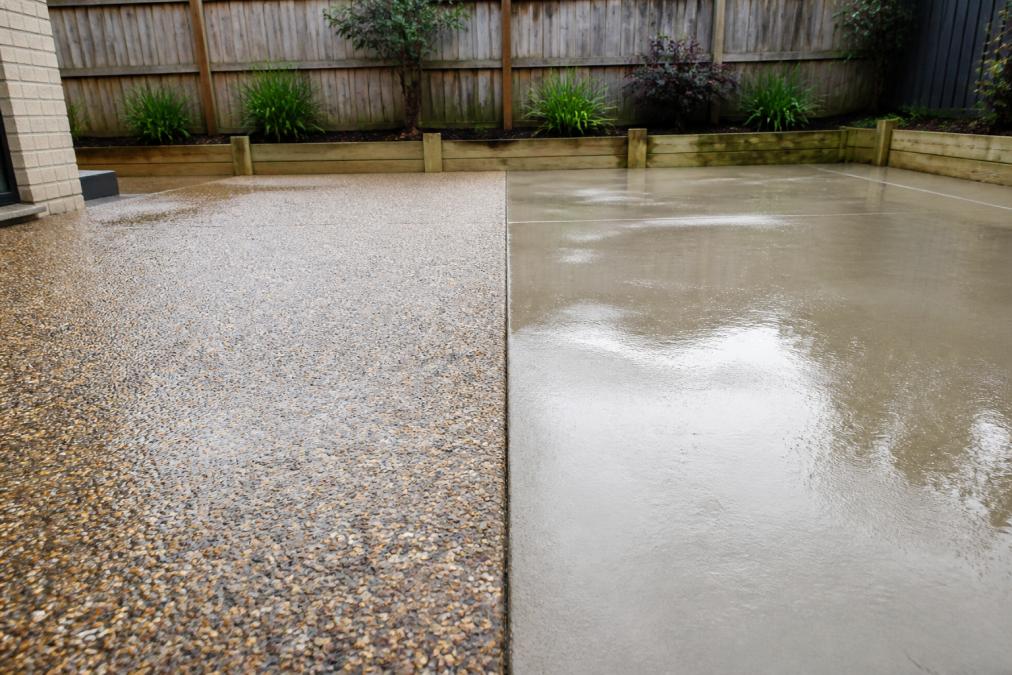
The core difference is how each surface handles movement. Concrete is rigid. When the ground shifts or temperatures swing, it cracks, and hairline cracks let water in, which worsens the problem. Pebble paving uses a resin-bound aggregate system that flexes slightly with the ground and sheds water across a textured, UV-resistant surface.
- Against cracking: pebble paving absorbs minor ground movement; concrete fractures
- Against staining: pebble paving wipes clean of oil and dirt; concrete absorbs both
- Against slipping: pebble paving keeps grip when wet; sealed concrete becomes slick
- Against fading: pebble paving holds colour under UV; concrete greys and chalks
For driveways and pool surrounds specifically, that combination of grip and drainage matters more than the initial price gap. Homeowners with existing cracked concrete often ask whether resurfacing hides the problem. Done properly, a pebble system bonds over the old slab and covers hairline cracks, provided the underlying concrete is structurally sound. If the slab is sinking or badly broken, that needs fixing first, and a straight answer about that is worth more than a quick sale.
Low Maintenance Patio Flooring for Busy Households
Low maintenance patio flooring is a surface that stays clean, safe, and presentable with nothing more than occasional sweeping and the odd wash down. For busy households and retirees, that rules out anything needing annual sealing, oiling, or repainting.
Pebble paving fits this brief well. Its non-slip surface resists mould and algae better than smooth finishes because water does not sit on it. A hose-down handles most dirt, and because the colour runs through the material rather than sitting on top, it does not need recoating to stay looking fresh.
Compare that with the alternatives. Timber decking needs oiling to stop it greying and splitting. Natural stone needs sealing to resist staining. Concrete needs resealing to stay water-resistant. Each task is manageable, but they stack up over the years.
For pool surrounds, check the slip rating before you buy, not after. Ask the supplier for the wet slip resistance classification, because a surface that feels grippy when dry can turn treacherous once wet. Textured finishes consistently outperform polished ones around water.
A practical routine for any outdoor surface: sweep weekly, wash monthly, and clear leaf litter from drainage points before winter. That alone prevents most of the problems homeowners blame on the material itself.
Outdoor Flooring Installation Costs: What Drives the Price
Outdoor flooring installation costs depend on four factors: surface area, site preparation, material choice, and access. Two quotes for the same sized patio can differ sharply because of what sits underneath. But the number that matters most is not the one on the quote, it is the total you will spend over the life of the surface.
Here is what actually moves the upfront number:
- Area: larger surfaces cost more, but the per-square-metre rate usually drops
- Preparation: removing old concrete, levelling, or repairing a damaged sub-floor adds labour
- Drainage: if water pools, falls may need correcting before any surface goes down
- Access: tight side entries or steep blocks slow the work and raise labour
- Material: natural stone and premium porcelain cost more than concrete or pebble finishes
Because pricing depends on quantity, site conditions, and access, the honest answer is that no two jobs price the same. Ask any installer to break the quote into preparation, materials, and labour, so you can see where the money goes.
The lifecycle cost most guides ignore
Upfront price is only the first line of the ledger. The real comparison is what each surface costs to own over 15 to 25 years, and that is where cheap surfaces stop looking cheap.
A common pattern across Victorian homes:
- Concrete is inexpensive to pour but needs resealing every few years to stay water-resistant. Skip it and the surface chalks, greys, and absorbs stains. Over two decades, resealing and the occasional crack repair add up to a meaningful second spend.
- Timber decking needs oiling or staining roughly annually, plus board replacement as boards split, cup, or rot. The labour alone, whether you do it yourself or pay someone, is the hidden cost.
- Natural stone needs sealing to resist staining, plus periodic deep cleaning to keep it looking premium. Beautiful, but rarely low-cost to own.
- Porcelain pavers are low-maintenance once down, but the upfront material cost is higher and repairs to a single cracked paver can be fiddly.
- Pebble paving typically needs nothing more than sweeping and the occasional wash down. No annual sealing, no oiling, no recoating. That is the whole point of the finish.
When you add it up, a surface that costs more on day one but needs almost nothing for the next 20 years often beats a cheaper surface that demands attention every year. The trap is comparing only the quote, not the decade.
When you compare quotes, ask each installer what the surface will need in years 3, 5, and 10, sealing, oiling, recoating, repairs. That answer, not the headline price, tells you which option is genuinely cheaper.
The most common mistake is choosing a quote on price alone and skipping sub-floor preparation. A cheap install over a cracked or uneven slab fails within a couple of years, and fixing it costs more than doing it properly the first time.
Pebble Mix provides a quote based on your actual site rather than a generic rate, so you know what you are paying for before work starts, and what you will not be paying for later.
Council Permits and Drainage Rules for Outdoor Surfaces
Most resurfacing projects on existing surfaces do not need a planning permit, but new hard surfaces, significant drainage changes, and work near boundaries often do. Rules vary between local councils, so the specific requirements for your property depend on where you live and what you are changing. This is the part of the project most guides skip entirely, and it is the part that can stall a build if you get it wrong.
When a permit is usually required
Across Victorian councils, the triggers tend to cluster around a few common situations:
- New hard surfaces above a certain size, particularly impermeable ones that increase stormwater runoff
- Work within a set distance of a boundary, where overshadowing, drainage, or easement rules may apply
- Changes to stormwater discharge, including new connections or altered flow paths
- Heritage overlays or significant landscape overlays, which add their own controls
- Easements, where building over or near a council or utility easement is restricted
Resurfacing over an existing slab rarely triggers a permit because the drainage picture does not change. Building a new surface from scratch is a different story, and it is worth a phone call to your council’s planning or building department before you commit.
The drainage principle that applies everywhere
The general principle across Victorian councils is that stormwater must not flow onto neighbouring properties or into the street’s drainage system beyond permitted limits (Stormwater). That is why permeable and free-draining surfaces have become the default recommendation for new work. A surface that lets water through reduces runoff and helps you stay within your council’s stormwater requirements.
This is also where material choice and compliance intersect. A free-draining pebble or permeable paver system can reduce the runoff a new surface generates, which in turn can affect whether a permit is needed at all. A solid impermeable slab does the opposite.
A practical checklist before you start
- Check whether your project needs a permit, based on size, location, and overlay controls
- Confirm what drainage and runoff rules apply to your block
- Identify any easements or boundary setbacks that affect where you can build
- Get the answer in writing where possible, so there is no ambiguity later
If you are unsure, ask your installer whether they have worked with your council before. Local experience with a council’s requirements often saves weeks of back-and-forth, and a good installer will flag permit triggers before you sign anything.
Where water already pools, correcting the fall matters more than the surface choice, and it is worth sorting out before installation rather than after. A surface installed over a drainage problem will fail regardless of how good the material is.
How to Choose the Best Outdoor Flooring for Your Melbourne Home
The best outdoor flooring for Melbourne is the surface that matches your site, your household, and your maintenance appetite, not the one with the lowest sticker price. Work through the decision in this order and the choice becomes straightforward.
If you have cracked concrete you want to hide: a pebble paving resurface covers hairline cracks and restores appearance without a full demolition, provided the slab is sound.
If you have a pool or young children: prioritise wet slip resistance above all else. A textured, free-draining finish is the safer call.
If you are retired or time-poor: choose a surface that needs no annual sealing or oiling. Lower upkeep beats a marginally lower purchase price.
If water pools after rain: fix the fall and drainage first. No surface performs well when it is sitting in a puddle.
If you want to add value: durability and appearance both matter to buyers. A surface that still looks new after a decade reads as a well-maintained property.
For many homes balancing cost, safety, and upkeep, a professionally installed pebble paving surface is a strong all-round option. It handles UV, drains well, stays grippy when wet, and cleans up with a hose, which is exactly what this climate demands.
Melbourne’s weather will expose any weak point in an outdoor surface, from summer UV to winter runoff. Pebble Mix has spent over 50 years installing UV-resistant, easy-to-clean pebble paving across Victorian patios, driveways, and pool surrounds, with customised colour options and professional supply and installation from start to finish. Our customers consistently point to reliable, professional service and a clean, polished result, including pool areas more than 20 years old brought back to looking brand new. Get started with Pebble Mix and transform your outdoor space with a surface built to last.
Frequently Asked Questions
What type of flooring is best for outdoors in Melbourne?
The best outdoor flooring for Melbourne depends on your priorities. Pebble paving suits driveways and pool surrounds because it resists UV and stays cool underfoot. Porcelain pavers work well for patios where a modern look matters. Composite decking appeals if you want a timber feel with less upkeep. Each handles the local mix of hot summers and cool, wet winters differently, so match the material to how you use the space.
Is pebble paving better than concrete for a Melbourne driveway?
Pebble paving covers hairline cracks that plain concrete shows over time, and its textured surface provides better grip when wet. Concrete is cheaper upfront but needs resealing every few years and can become slippery. For driveways exposed to heavy rain and traffic wear, pebble paving offers a longer-lasting finish with less ongoing work, though the initial outlay is higher.
How much does outdoor flooring installation cost in Melbourne?
Outdoor flooring installation costs vary based on the area size, material chosen, site access, and whether sub-floor preparation or drainage work is needed. Pebble paving, porcelain, and composite decking each sit in different price brackets. Because every yard is different, the most accurate figure comes from a site assessment and written quote rather than a generic per-square-metre rate.
Do I need a council permit for outdoor paving in Melbourne?
Many straightforward paving jobs on private land do not need a permit, but you will need one if the work affects drainage, crosses easements, or changes stormwater flow toward neighbouring properties. Some councils also require approval for hard surfaces that increase runoff. Check with your local council before starting, especially for driveway crossovers or large impermeable areas.